

“The best thing you can do with DNAnexus is give them a problem to solve.”
Jeffrey Reid, VP, Chief Data Officer | Regeneron Genetics Center
Solutions
Resources
Company
PRODUCTS
Every regulator and every sponsor already has a system of record. What has been missing is the trusted ground between them.

















Pharma chooses TRS™ when a submission has to be understood by multiple global health authorities without anyone giving up control of their data.
Sponsors keep their regulatory truth in a RIM system; agencies keep theirs behind a submission gateway. Nothing sits between the two, so questions travel as informal correspondence, and task status is something one side has to ask the other for. TRS is the missing layer: a federated network of membership-governed spaces where sponsors and agencies work securely on the same artifacts with the same tools.
A sponsor presents a RIM-derived view of a submission in a bilateral space and invites the agency to explore it with shared tools. Agencies never reach the sponsor's RIM; sponsors never reach agency review systems; the two interact in a secure collaborative space between those heavily protected domains.
One lens. The same eCTD or dataset, the same validators and visualizers, inside the space.
Subscribed, not sent. Questions and answers are tracked tasks that both parties subscribe to, each with an owner, a state, and a deadline; status is read, never requested.
Documents in the space. Word co-editing with enforced change tracking; images and tables pasted straight into the exchange; nothing on a cc: list.
Outcome: Fewer formal cycles and faster answers, with a complete audit trail and the submission of record unchanged.
Project Orbis and the Access Consortium proved agencies will review in parallel when given a way to do it. What held them back was document sharing with no tools inside the boundary and a central data store that presents real data-governance challenges for many global regulators. TRS maps the reliance pattern onto spaces instead.
Bilateral by default. Each sponsor-agency channel is its own space with its own stakeholder-owned data store.
An agency-only room.
Authorities confer in a space the sponsor is never a member of.
Two review models. Coordinated regional review with a reference assessment, or independent national review of the same authentic dossier.
Outcome: One sponsor exchange; each authority keeps its own sovereignty while sharing tools and observations with their agency partners.
ICH M11 protocols, ICH M4Q(R2) quality information, and FHIR-based labeling only pay off when all parties can validate and visualize them together. On TRS the tools come to the data.
M11 and PAC-CMC reviewers.
Protocol conformance against M11 and USDM; process and M4Q(R2) views into post-approval changes.
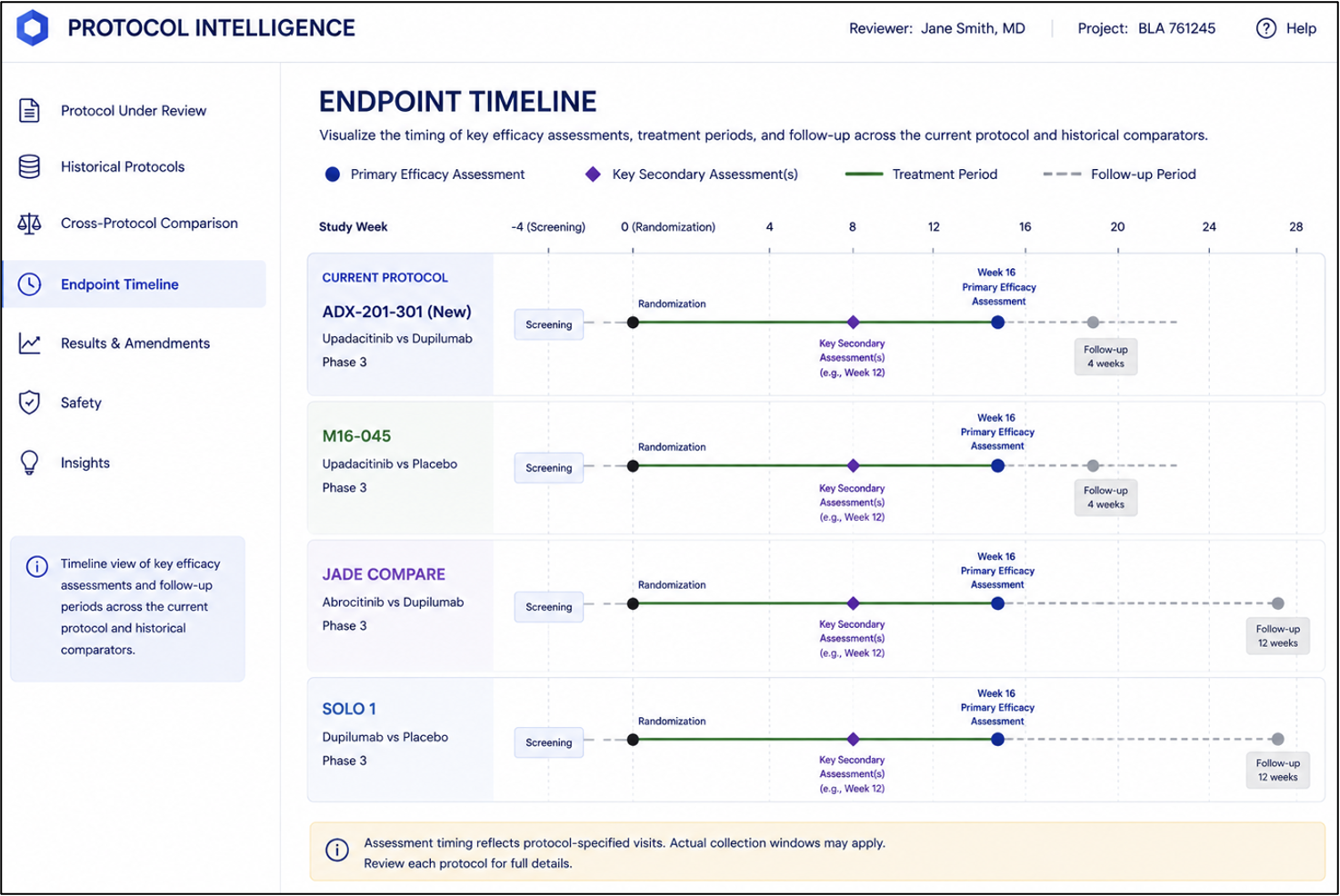
Protocol Intelligence.
Legacy PDF protocols extracted into M11 fields, verbatim and page-cited, and compared against historical precedent in the same therapeutic area. AI commentary is labeled and kept separate; protocols never leave the environment.
Partner tools inside the boundary.
LORENZ docuBridge for submission navigation and annotation.
Outcome:
Digitalization initiatives that reach production, and a federated view of AI-ready regulatory information.
“The best thing you can do with DNAnexus is give them a problem to solve.”

“Security is super important to us and the DNAnexus platform has an absolutely fantastic security model underneath.”

"DNAnexus has made it easy for us to remove the costs and technical headaches associated with building a do-it-yourself alternative."

15 September 2026
Planning for the growth and maturation of a diagnostic pipeline can be daunting. DNAnexus offers four packages to help enable diagnostic test providers during whatever stage they are in.
Clinical Diagnostics
23 July 2026
Explore the future of bioinformatics with harmonized, AI-ready data that transforms clinical workflows, enhances precision medicine, and drives drug discovery.

30 June 2026
Discover how integrating multi-omic data can uncover insights into patient responses to therapies, driving advancements in cell, gene, and RNA research.